(Reverse Chronology, Scroll Down for Oldest and then Up for Newest)

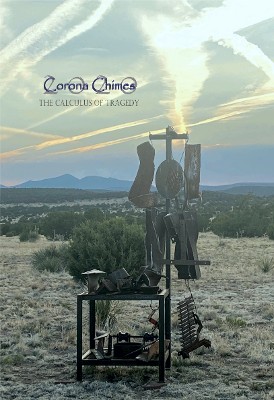
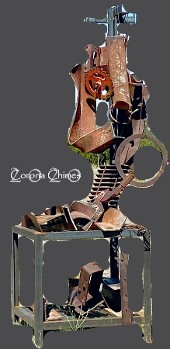
An operating wind chimes commemorating the COVID-19 Pandemic.
Installed at the Valdez Sculpture Field, south of the cemetary
on the wind-swept plains of the Estancia Basin, New Mexico.
Recently exhibited at the Tijeras, NM Village Hall.
An Interactive Component Art System
"...the robust scrap structural steel has the fantastically eerie
acoustics between artist Harry Bertoia's Sonambient sound
sculptures and the squeals of Neil Young's wailing guitar
intros of his anthem/ballads "Ohio" and "Southern Man."
 _
_ 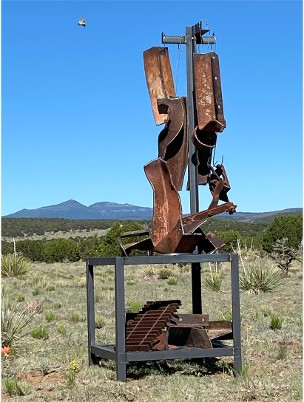
Corona Chimes 2020 (with Ferruginous Hawk above).
Twin Peaks, Manzano Mountains, Tajique, NM. Photo Jeff Laird
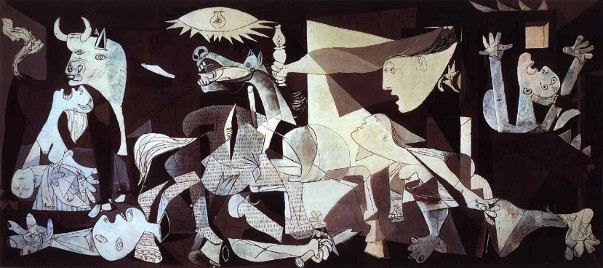
the calculus of tragedy
guernica, 1937, pablo picasso. est. $200 Million (2021)
************************************************
Other Interactive Component Art Systems
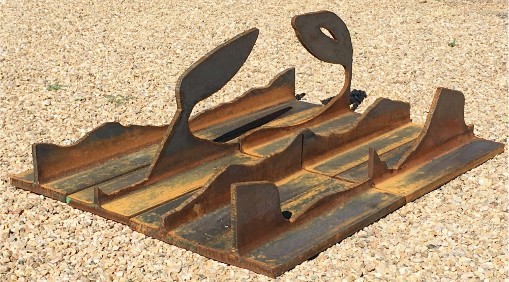
Left: Reach, 2019, Oxidized scrap steel I-beams, 48" x 48" Interactive Component Art System.
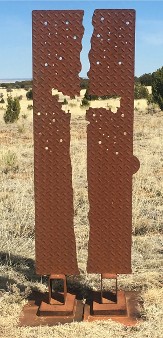
Right: Rio Cruz, 2010, Oxidized diamond plate steel, 48".
-----------------------------------------------------------------------------------------------------------------------------------------------
Perforated Aluminum and Aluminum Sculpture
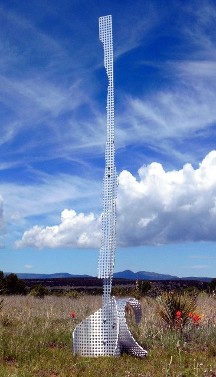
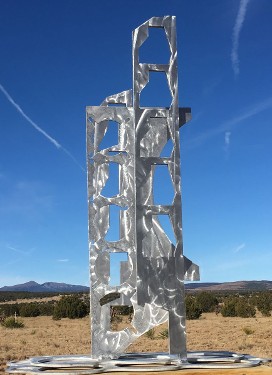
Hook Shaft Yucca, 2010, 8' to 25'. Cut-Out Hook Shafts, 2020, 36" (3 pieces)
**********************************************************************************************
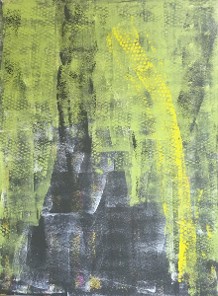
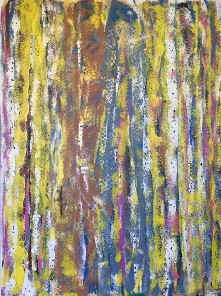
The Flat-Depth Painted-Over Paintings
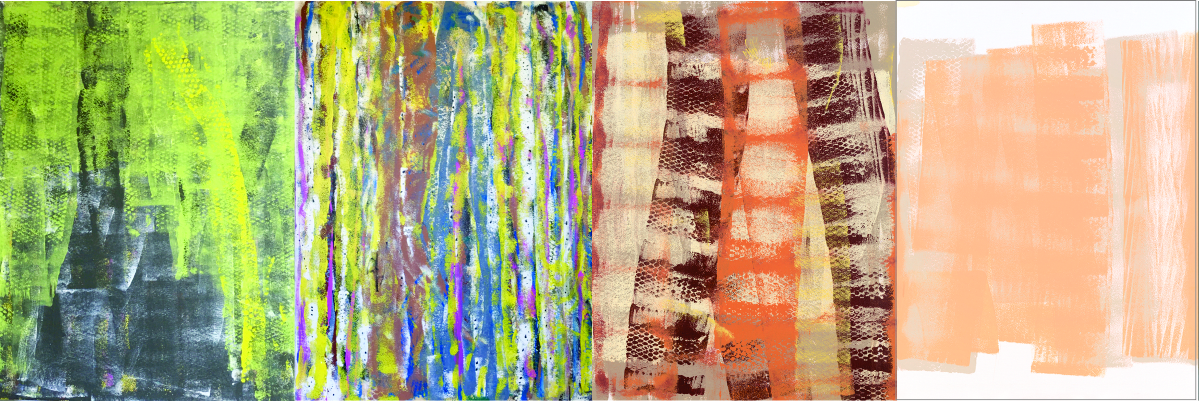
FOUR SEASONS. Spring, Summer, Fall, Winter, 2019, acrylic on canvas, 48" x 144" (quadriptych, each panel 48" x 36")
##############################################################
From The Archives - Liturgical Art Group Show
Social Hall, First Unitarian Church 3701 Carlisle NE, Albuquerque, NM | uuabq.com Spring 2020
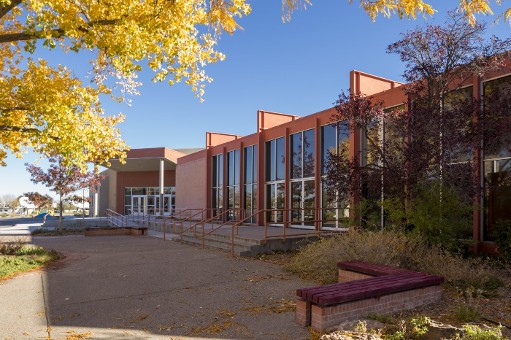
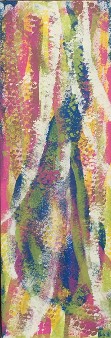
Social Hall (right): Built 1964, Architect: Harvey Hoshour, Restored 2020. Silver on White Cross. Drop.
__________________________________________________________________
T H E A R T I C H O K E C A F E
424 CENTRAL SE, ALBUQUERQUE, NM 87102
artichokecafe.com
 ******************************************************** Algodones Gallery, I-25 Algodones, NM
662 East Frontage Rd. (I-25), Algodones, NM 87001.
Only 20 minutes north of the Big I. Open Daily 10 - 5 pm, 7 days a week.
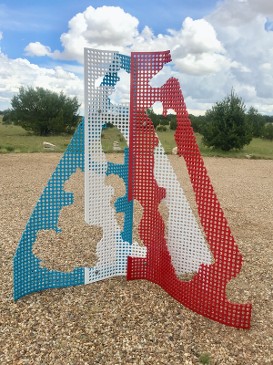
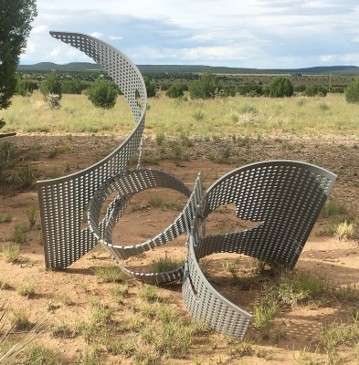
Red, White and Blue Turquoise Triangles, 3 Triangular Cylinders (gray), powder coated perforated
******************************************************************************************************************************
CHUMANI GALLERY (see below)
Only 30 minutes south of the Santa Fe Plaza
2839 NM 14, Madrid, NM | Open Daily 10 - 5 | 505-424-3813
Oxidized Steel Sculpture Featured Below.
• Chariots - Wind Machine Fleet - 2 still available
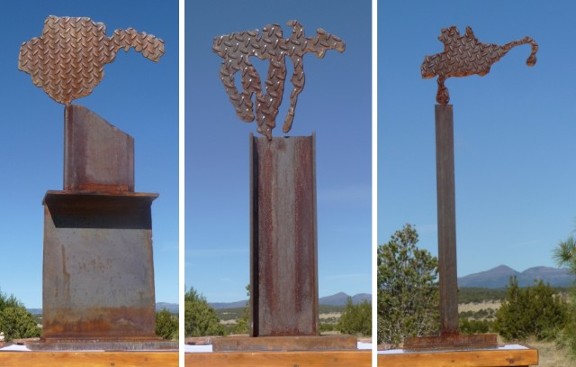
• Avianic / Structural Steel Series - several available
^^^^^^^^^^^^^^^^^^^^^^^^^^^^^^^^^^^^^^^^^^^^^^^^^^^^^^^^^^^^^^^^^^^^^^^^^^^^^^^^^^^^^^^^^^^^
Other Work
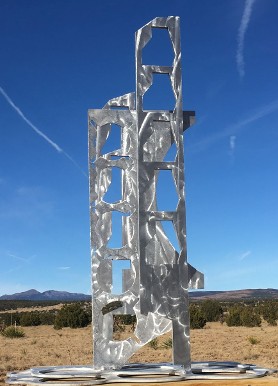
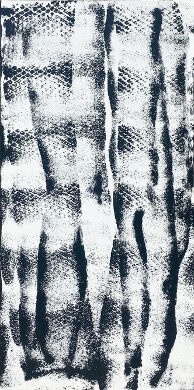
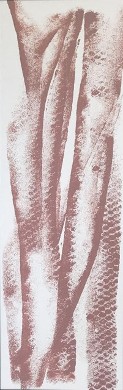
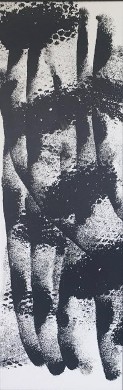
Hook Shafts Cutouts (3 pieces); Black Cylinders; Lithe; Swell 4
++++++++++++++++++++++++++++++++++++++++++++++++++++++++++++++++++++++++++++++++++++++++
Crumpled Metal Sculpture
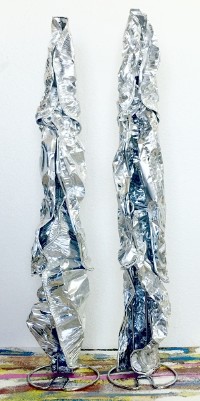
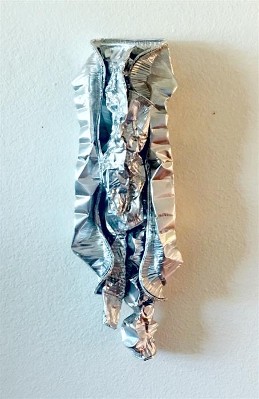
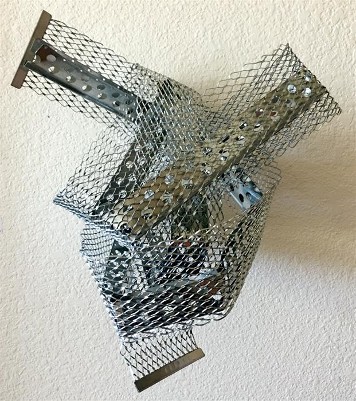
Giacometti Candlesticks, Squeeze, Crumpled Wire Mesh
*************************************************************************************************************
Embellished (found) Objects
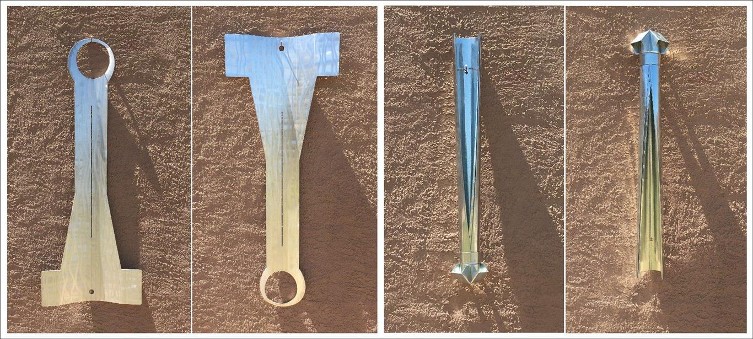
RIGHT SIDE UP / UPSIDE DOWN
BulbTop, natural aluminum, 55" tall. PipeDuct/Cap, galvanized steel, 37" tall.

*******************************************************************************************************************
perforated HOOK SHAFTS & Triangular Cylinders
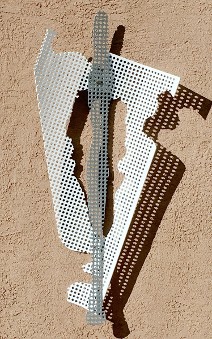
This series is a continuation of the Perforated Triangles (see below) using the recycled 1/4" thick perforated
aluminum. It is an exploration of the nature of verticality and the synthesis of organic and linear shapes.
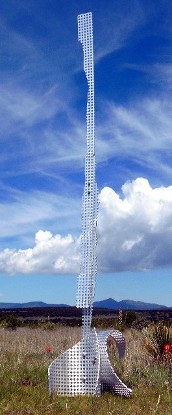
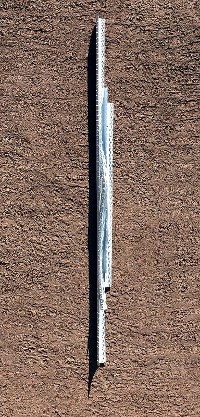
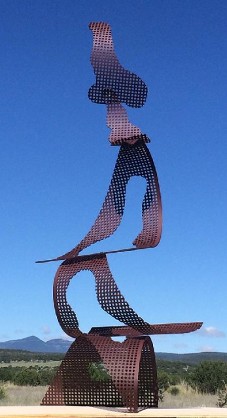
Hook Shaft Yucca, TRIM-TEX Hook Shaft 1.5, Triangular Cylinder Tower
*****************************************************************************
The VERTICAL in Modern Art - Origin of the Hook Shafts
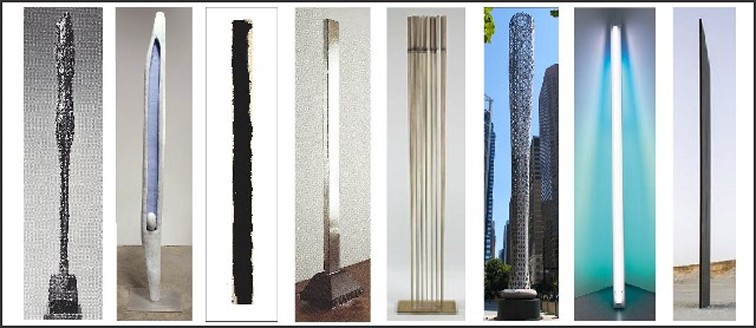
Giacometti. Bourgeois. Newman. Bertoia. Oldenburg + van Bruggen. Flavin. Serra
Artists have been fascinated with the VERTICAL for eons. But it wasn't until Alberto Giacometti challenged our perception of the female form in 1947 that the race to discover the true meaning of vertical began. Louise Bourgeois's Totems provided an exploration of abstracted perceptual ambiguity. Barnett Newman's zip paintings and sculptures took it to its' minimalist essence. Harry Bertoia made vertical sound sculpture. Claes Oldenburg and Coosje van Bruggen celebrated Chicago's baseball and high-rise architecture with BatColumn. Dan Flavin illuminated the vertical with flourescent light bulbs. Finally, the purest expression of vertical appears in the uber-austere edge of a Richard Serra steel monolith in the torrid Arabian desert. And so the search continues with Hook Shafts.
**********************************************************
The Perforated Polygons
An Interactive Component Art System
•Perforated Triangles •Perforated Pentagons
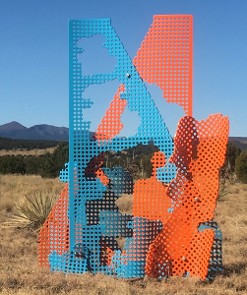
The Perforated Triangles are an interactive component art system consisting of a series of thirteen colorful triangles
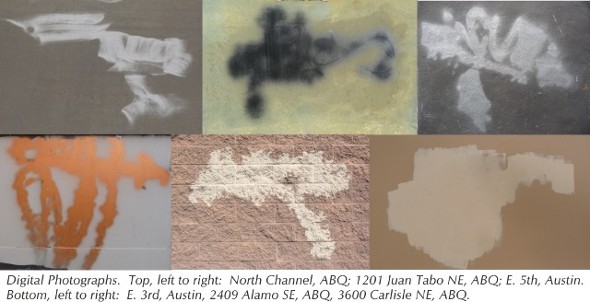
made from 49" tall recyled 1/4" thick perforated aluminum which retain a portion of the shapes and lines of the original fabrication of metal stair balluster panels. Each is unique and idividually made, not a multiple edition. Organic shapes of painted-over graffiti forms are cut out of each triangle and bolted to it. The triangles are softly rolled to accentuate the
planar attributes. The triangles can be displayed on the wall or bolted together for floor display.
They can be bolted with other components from the later sub series.
The colors are as whimsical as the forms, and are meant to comment on many societal idiosyncracies.
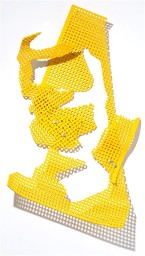
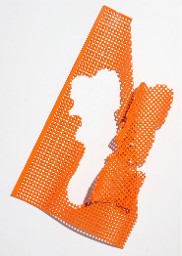
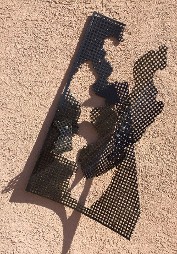
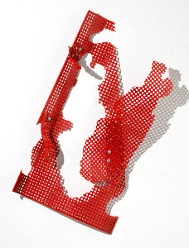
French's Mustard Yellow, OSHA Orange, Diamond Black, Ruby Red
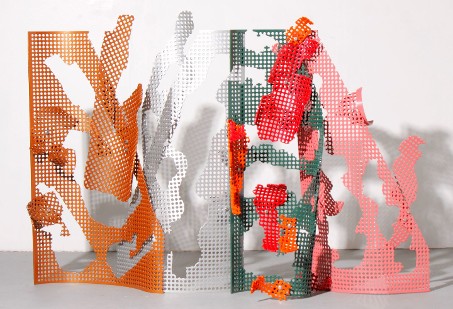
CopperSun, Sparkle Silver, 7 ELEVEN, Coral
-------------------------------------------------------------------------------------------------------------------------------------
The Camouflage + Spray Triangles (After Warhol)
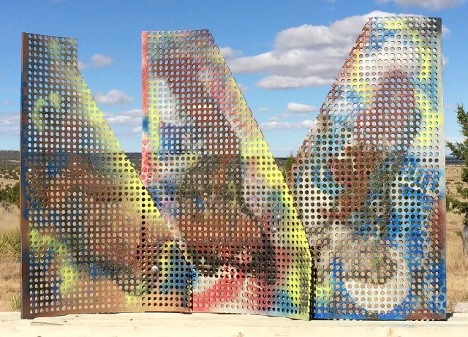
_______________________________________________
The Perforated Pentagons
(On view at Tijeras, NM Village Hall)
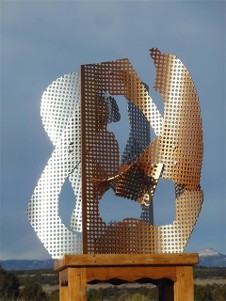
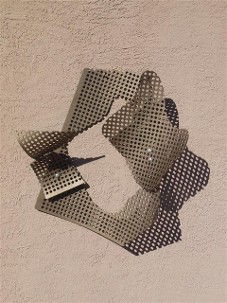
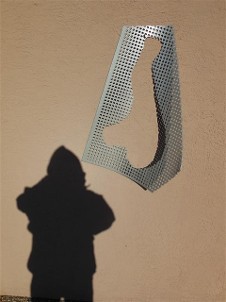
Origin of The Perforated Triangles
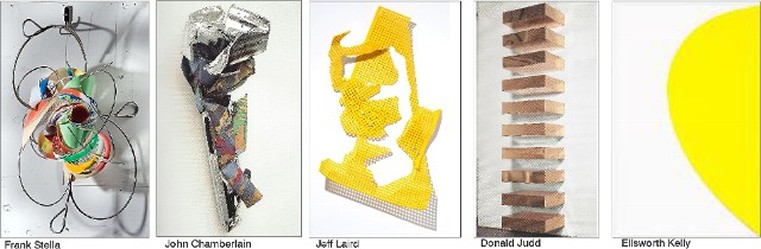
The Perforated Triangles are recycled perforated aluminum designed as a flexible component
system of powder coated aluminum pieces bolted together with stainless steel fasteners. They are a
synthesis of the works of four great masters of Modern Art - Donald Judd and John Chamberlain,
with a dash of Ellsworth Kelly and Frank Stella.
Light rays bounce off the repetitious perforations producing a unique, solid pixilation, while over-lapping
perforations create fascinating moire patterns. Cutout Rorschachian irregular forms, one positive, one
negative, commandingly contrast the anonymous perforations. The quirky straight lines, carrying the DNA
from the original fabrication, encourage contemplation of their own perceptual ambiguity.
The design allows for maximum flexiblitly - individual sculptures may be hung horizontally, vertically, or
canted (shown above). Sculptures may be displayed individually, or combined in a variety of ways to
create both wall and floor installations, as well as outside combinations. They can be combined as dual
"combos", multi-sculpture "fences", or "stacked" (a Juddian term) horizontally. Plans are underway to
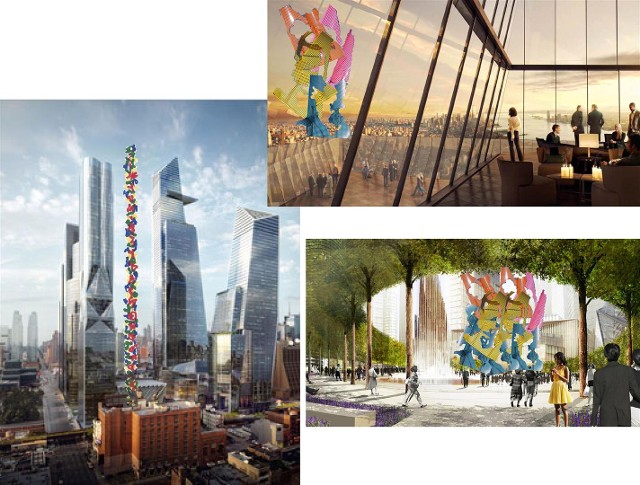
create the world's largest sculpture of Perforated Triangles for the Hudson Yards development in NYC.
The colors comment on several contemporary societal phenomena - NFL Pink, OSHA Orange, French's
Mustard Yellow, Sparkle Silver, 7 ELEVEN, Glitter Black, Rugy Red, Frigidaire Wet White, Purple Martin.
***************************************************************************************************************************
Organica XLT
Proposal for The Tallest Green Sculpture at Hudson Yards, NYC (Unrealized)
********************************************************************************************************************
CHUMANI GALLERY
Only 30 minutes from the Santa Fe Plaza
2839 NM #14 North, Madrid, NM | Open Daily 9 to 5 | 505-424-3813
CHARIOTS - The Wind Machines
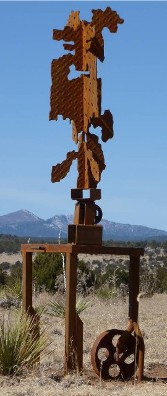
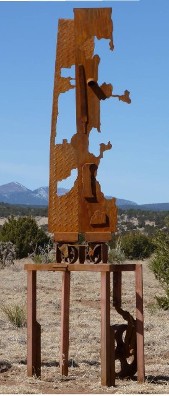

Wind Catcher 72" H & Wind Evader 82" H. Oxicized steel, vintage mining wheels.
______________________________________________________________________________________________
Chariots and Other Chassis in Modern Art
By Jeff Laird
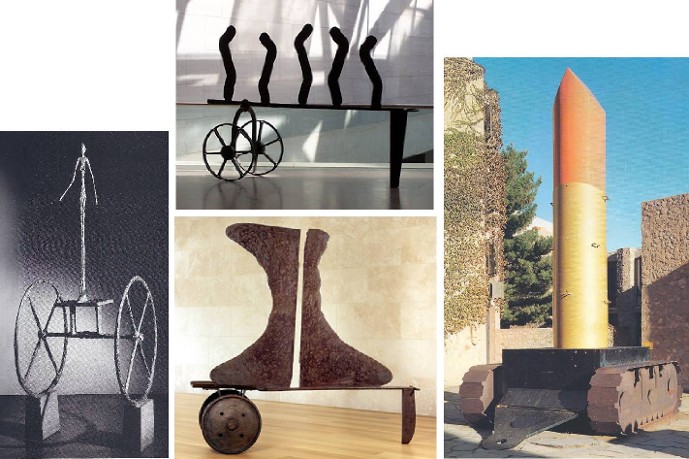
L to R: CHARIOT, 1950, Alberto Giacometti, MoMA. Top: Voltri VII, 1962, David Smith, National Gallery, Wash., Bottom: Voltri VI, 1962,
David Smith, Nasher Sculpture Center, Dallas. Lipstick on Caterpillar, 1969-74, Claes Oldenberg, Yale University.
___________________________________________________________________________________________________________________________ .
CHUMANI GALLERY
Madrid, NM
The Avianic Structural Steel Series
 ***************************************************************************************************************************
